top of page

Connecting the Study on Children’s Prosocial Behavior with George Herbert Mead’s Socialization Theory

  • 작성자 사진: Seoheon Kim
    Seoheon Kim
  • 2025년 7월 18일
  • 2분 분량

July 12, 2025
Seoheon “Sean” Kim


The study titled “The Impact of Socialisation on Children’s Prosocial Behaviour: A Study on Primary School Students” investigates how various social factors, such as family education level, peer interaction, cyberbullying, and gender role adherence, affect children’s prosocial tendencies. While George Herbert Mead’s name is not directly mentioned in the study, many of its findings can be meaningfully connected to Mead’s theory of socialization.
Mead’s socialization theory emphasizes that individuals develop their sense of self and social behaviors through three progressive stages: imitation, play, and game. In the imitation stage, children observe and mimic the behaviors of those around them without fully understanding social roles. In the play stage, they begin to assume specific roles, experimenting with different social positions. Finally, in the game stage, children internalize complex social expectations and learn to see themselves from the perspective of the generalized other.
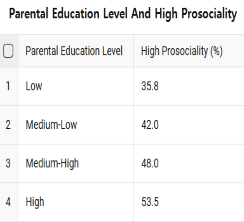
The findings of the prosocial behavior study closely align with this framework in several ways. First, the study highlights the importance of family background, particularly parental education level, in promoting prosocial behavior. According to Mead, primary socialization begins within the family. During the imitation stage, children absorb behaviors and values directly from parents and immediate caregivers. The study’s result—that children with more highly educated parents exhibit higher prosociality—supports Mead’s idea that early exposure to positive role models is essential in forming social values.


Second, the role of peer interaction resonates with Mead’s play and game stages. The study found that children who spent more time interacting face-to-face with peers, including participating in sports, showed higher prosociality. Conversely, those who primarily engaged in online interactions displayed lower prosocial tendencies. According to Mead, the play and game stages help children learn cooperation, empathy, and social norms by engaging with others in shared activities. This suggests that reduced real-world interaction, replaced by digital engagement, may hinder the development of these skills.
Third, the study addresses the negative impact of cyberbullying on prosocial behavior. Children involved in cyberbullying, either as victims or perpetrators, were shown to have lower prosocial tendencies. From a Mead’s perspective, this can be interpreted as a distorted form of socialization. If children imitate harmful behaviors they observe in online environments—especially without adult guidance—they may internalize antisocial rather than prosocial roles during the imitation and play stages.
Finally, the study discusses the influence of gender role stereotypes on prosociality. Mead’s concept of the generalized other includes the internalization of societal expectations, including gender norms. The study’s finding that rigid adherence to gender roles correlates with lower prosocial behavior suggests that overly strict social conditioning may limit a child’s capacity for flexible, empathetic social responses. This aligns with Mead’s theory that while the generalized other shapes the self, excessive rigidity in these social norms can have negative consequences.
In conclusion, although the study on children’s prosocial behavior is based on quantitative social research rather than symbolic interactionism, its results echo key aspects of George Herbert Mead’s socialization theory. Both emphasize the foundational role of family, peer interaction, and societal norms in shaping individuals’ social behaviors. The study thereby provides empirical support for Mead’s theoretical framework in the context of contemporary issues such as screen time and cyberbullying.
 
Reference.
Tintori, A., Ciancimino, G., Palomba, R., Clementi, C., & Cerbara, L. (2021). The Impact of Socialisation on Children’s Prosocial Behaviour: A Study on Primary School Students. International Journal of Environmental Research and Public Health. 2021;18(22), 12017.

댓글


등록번호 : 경기 아54388 | 등록일 : 2025-04-11
발행인 : 신종철 | 편집인 : 신종철
주소 : 경기 성남시 분당구 느티로 16 (정자동, 젤존타워1), 904호
전화번호 : 010-7379-6454
청소년보호책임자 : 신종철


© 2025 by 국제edu. Powered and secured by Wix 


bottom of page